Human Population Genetics and Genomics ISSN 2770-5005
Human Population Genetics and Genomics 2026;6(2):0004 | https://doi.org/10.47248/hpgg2606020004
Technical Note Open Access
Clumppling 2.0: A Clustering Alignment Program for Population Structure Analyses
Xiran Liu
1

 ,
Noah A. Rosenberg
2
,
Sohini Ramachandran
1,3
,
Noah A. Rosenberg
2
,
Sohini Ramachandran
1,3
Correspondence: Xiran Liu
Academic Editor(s): Joshua Akey, Carina Schlebusch, Torsten Günther
Received: Nov 21, 2025 | Accepted: Feb 24, 2026 | Published: Mar 17, 2026
This article belongs to the Collection Population Genetics Methods and Software
Cite this article: Liu X, Rosenberg NA, Ramachandran S. Clumppling 2.0: A Clustering Alignment Program for Population Structure Analyses. Hum Popul Genet Genom. 2026;6(2):0004. https://doi.org/10.47248/hpgg2606020004
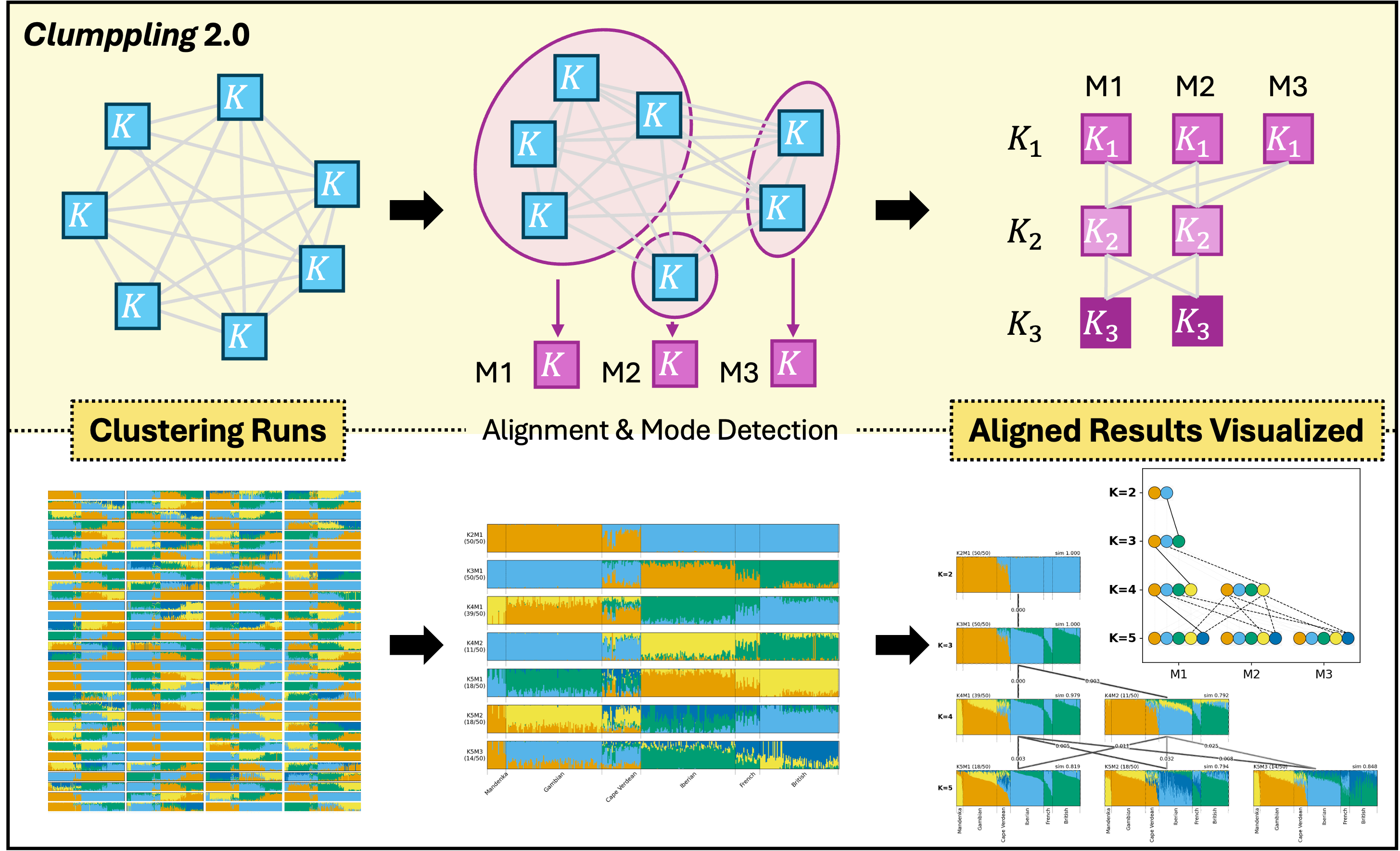
We previously introduced
admixture, alignment, clustering, genetic ancestry, population structure
Share this article




Copyright © 2026 Pivot Science Publications Corp. - unless otherwise stated | Terms and Conditions | Privacy Policy