Green Energy and Sustainability ISSN 2771-1641
Green Energy and Sustainability 2026;6(2):0005 | https://doi.org/10.47248/ges2606020005
Original Research Open Access
Investigation of the charging of a latent-heat storage tank with encapsulated erythritol for concentrating solar systems
Nikolaos Papadimitriou

 ,
Vassilios Belessiotis
,
Elias Papanicolaou
,
Vassilios Belessiotis
,
Elias Papanicolaou
Correspondence: Elias Papanicolaou
Academic Editor(s): Tony Roskilly, Georgios Martinopoulos, Georgia Kastrinaki, Hande Eryilmaz, Martin Roeb
Received: Oct 31, 2025 | Accepted: Apr 28, 2026 | Published: May 13, 2026
This article belongs to the Special Issue Selected Papers from the Conference ICRES 2025
Cite this article: Papadimitriou N, Belessiotis V, Papanicolaou E. Investigation of the charging of a latent-heat storage tank with encapsulated erythritol for concentrating solar systems. Green Energy Sustain. 2026;6(2):0005. https://doi.org/10.47248/ges2606020005
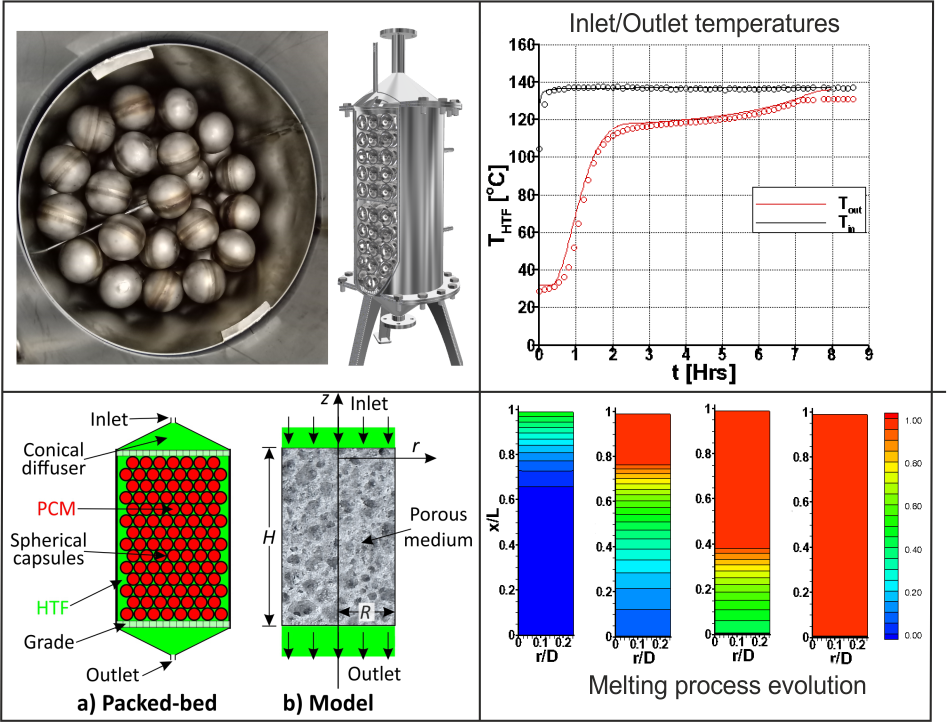
This work concerns thermal energy storage in the medium-temperature range (100 – 250 °C), which is typical of parabolic-trough concentrating solar power (CSP) systems. Within this context, the use of phase change materials (PCMs) has been drawing attention in recent years as a promising technology. A class of PCMs suitable for the specific temperature range are sugar-alcohols and, among those, meso-erythritol (melting point: 118 °C) has been selected here as a such representative compound. Both experimental and computational methods are being used, whereby the experimental part of the work is carried out in a pilot facility, which is a hydraulic loop integrating a 100 L cylindrical storage tank. This is loaded with 200 hollow spherical containers (capsules) of 7.5 cm diameter made of steel, containing the PCM and forming a packed-bed arrangement. This offers a large surface area allowing for good heat transfer between the storage medium and the circulating heat transfer fluid, which is here a thermal oil (Therminol). For the computational work, a packed-bed model is used, considering the tank as a porous medium consisting of two phases (fluid and PCM) thermally interacting with each other and the continuous solid phase approach is used for the PCM, with suitable treatment of the phase-change in the energy equation. The model is validated and used for comparisons with preliminary experiments for the charging of the tank showing good agreement. Subsequently, a parametric investigation is carried out based on the model, by considering additional values of the main thermal-hydraulic parameters, such as oil flow rate and inlet temperature, and their effect on the melting rate and the charging efficiency are investigated. For a period of 8 hours, typical of a daily cycle of operation of a solar energy system, the evolution of the phase change process is evaluated from the numerical results for all parameters considered. It is shown for which values of these parameters the melting process can not be completed within the chosen time period and, thus, careful selection is needed when designing a storage system based on the given storage concept for optimum utilization of the harvested solar energy.
Keywordsthermal energy storage, latent heat, phase change material, packed-bed, erythritol
Share this article




Copyright © 2026 Pivot Science Publications Corp. - unless otherwise stated | Terms and Conditions | Privacy Policy