Cancer Heterogeneity and Plasticity ISSN 2818-7792
Cancer Heterogeneity and Plasticity 2026;3(1):0003 | https://doi.org/10.47248/chp2603010003
Original Research Open Access
YAP1 depletion enhances TAZ and its complexation with TEAD4 and AP-1 heterodimer C-JUN/FOSB in gastric cancer progression and metastasis
Jingjing Wu
1,2
 ,
Dipti Athavale
3,4
,
Curt Balch
3,4
,
Junsong Zhao
3,4
,
Gengyi Zou
1
,
Yibo Fan
1
,
Yanting Zhang
3,4,5
,
Joseph Zhao
6
,
Mikel Ghelfi
3,4
,
Anthony Pompetti
3,4
,
Gennaro Calendo
3,4
,
Ailing Scott
1
,
Shan Shao
1
,
Xiaodan Yao
3,4
,
Melissa Pool Pizzi
1
,
Christopher Vellano
7
,
Vladimir Khazak
8
,
Sheng Zhang
2
,
Timothy A Yap
9
,
Shilpa S Dhar
1
,
Raghav Sundar
6
,
Francis Spitz
4,5,10
,
Generosa Grana
4,10
,
Jaffer A. Ajani
1
,
Shumei Song
3,4,5,10,11
,
Dipti Athavale
3,4
,
Curt Balch
3,4
,
Junsong Zhao
3,4
,
Gengyi Zou
1
,
Yibo Fan
1
,
Yanting Zhang
3,4,5
,
Joseph Zhao
6
,
Mikel Ghelfi
3,4
,
Anthony Pompetti
3,4
,
Gennaro Calendo
3,4
,
Ailing Scott
1
,
Shan Shao
1
,
Xiaodan Yao
3,4
,
Melissa Pool Pizzi
1
,
Christopher Vellano
7
,
Vladimir Khazak
8
,
Sheng Zhang
2
,
Timothy A Yap
9
,
Shilpa S Dhar
1
,
Raghav Sundar
6
,
Francis Spitz
4,5,10
,
Generosa Grana
4,10
,
Jaffer A. Ajani
1
,
Shumei Song
3,4,5,10,11
Correspondence: Jaffer A. Ajani; Shumei Song
Academic Editor(s): Dean G. Tang
Received: Jan 16, 2026 | Accepted: Mar 17, 2026 | Published: Mar 28, 2026
Cite this article: Wu J, Athavale D, Balch C, Zhao J, Zou G, Fan Y, Zhang Y, Zhao J, Ghelfi M, Pompetti A, Calendo G, Scott A, Shao S, Yao X, Pizzi MP, Vellano C, Khazak V, Zhang S, Yap TA, Dhar SS, Sundar R, Spitz F, Grana G, Ajani JA, Song S. YAP1 depletion enhances TAZ and its complexation with TEAD4 and AP-1 heterodimer C-JUN/FOSB in gastric cancer progression and metastasis. Cancer Heterog Plast. 2026;3(1):0003. https://doi.org/10.47248/chp2603010003
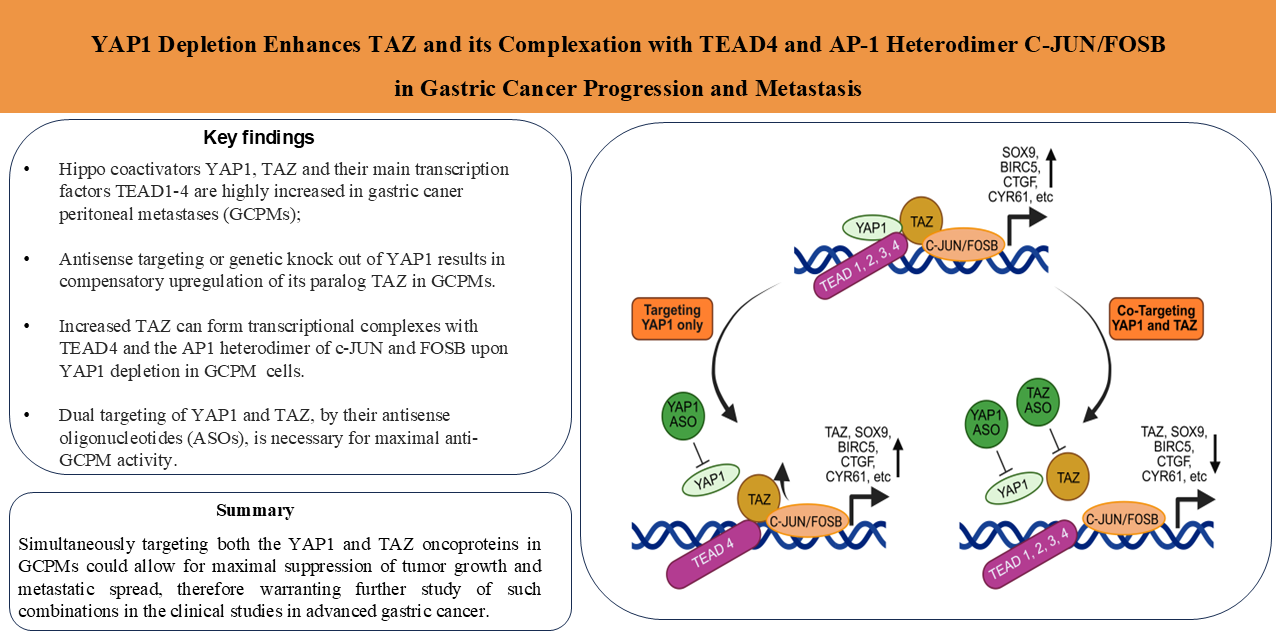
Background: Dysregulation of the Hippo signaling pathway, characterized by aberrant activation of the transcriptional coactivators YAP1 and TAZ, drives tumor progression, immunosuppression, and metastasis. Hippo pathway components are emerging therapeutic targets in several solid tumors, however, the expression profiles of Hippo coactivators YAP1, TAZ, and their transcriptional factors TEAD1-4 in gastric cancer peritoneal metastases (GCPMs), and their therapeutic value, are unknown. In this study, we sought to determine the expression status of YAP1, TAZ, and TEAD1-4 in GCPMs and to evaluate whether dual targeting of YAP1 and TAZ provides superior antitumor activity compared with inhibition of either coactivator alone.
Methods: Expression of YAP1, TAZ, and TEAD1–4 was examined in GCPMs by single-cell RNA sequencing and co-immunofluorescent staining. Functional studies using genetic knockout and antisense oligonucleotide (ASO) inhibition of YAP1 or TAZ were performed to assess antineoplastic effects in vitro and in vivo. Co-immunoprecipitation and luciferase reporter assays were used to characterize YAP1/TAZ interactions with TEADs and AP-1 components (JUN and FOSB) and to quantify transcriptional activity. Antitumor efficacy was validated in patient-derived xenograft (PDX) and KP-Luc2 syngeneic models.
Results: YAP1, TAZ, and TEADs1-4 were highly coexpressed in GCPMs and correlated with poor survival. YAP1 inhibition alone elicited compensatory upregulation of TAZ, while combined inhibition of both coactivators maximally repressed cell proliferation and invasion in vitro, and tumor growth in vivo. Increased TAZ complexation with TEAD4 and AP-1 (c-JUN and FOSB) heterodimer was observed following YAP1 knockdown or pharmacological ASO inhibition. Dual inhibition of YAP1 and TAZ was required to maximally suppress YAP1/TAZ expression and reduce their nuclear accumulation, transactivation of TEAD, and activation of downstream genes.
Conclusions: These findings show that combined YAP1 and TAZ inhibition holds promise for the treatment of GCPM, a highly lethal disease with an urgent need for novel treatment options.
KeywordsAntisense oligonucleotide (ASO), gastric cancer peritoneal metastasis (GCPM), Hippo pathway, YAP1, TAZ, TEAD1-TEAD4, targeted therapy
Share this article




Copyright © 2026 Pivot Science Publications Corp. - unless otherwise stated | Terms and Conditions | Privacy Policy