Cancer Heterogeneity and Plasticity ISSN 2818-7792
Cancer Heterogeneity and Plasticity 2026;3(1):0002 | https://doi.org/10.47248/chp2603010002
Review Open Access
Molecular heterogeneity of HPV-associated cancers and strategies to overcome treatment resistance
Sara Rasouli
1,2,†
 ,
Weiyi Gong
1,2,†
,
Raegan Wood
2,3
,
Danyal Daneshdoust
1
,
Anam Khan
1
,
Rani Mahyoob
1
,
Chongwen Cao
1
,
Zihao Yu
1
,
Nagireddy Putluri
4
,
Gennady Shvets
5
,
Haichang Li
6
,
Bo Zhao
7
,
Xuefeng Liu
1,8
,
Jenny Li
1,9
,
Weiyi Gong
1,2,†
,
Raegan Wood
2,3
,
Danyal Daneshdoust
1
,
Anam Khan
1
,
Rani Mahyoob
1
,
Chongwen Cao
1
,
Zihao Yu
1
,
Nagireddy Putluri
4
,
Gennady Shvets
5
,
Haichang Li
6
,
Bo Zhao
7
,
Xuefeng Liu
1,8
,
Jenny Li
1,9
Correspondence: Xuefeng Liu; Jenny Li
Academic Editor(s): Dean G. Tang
Received: Jul 23, 2025 | Accepted: Feb 9, 2026 | Published: Mar 1, 2026
Cite this article: Rasouli S, Gong W, Wood R, Daneshdoust D, Khan A, Mahyoob R, Cao C, Yu Z, Putluri N, Shvets G, Li H, Zhao B, Liu X, Li J. Molecular heterogeneity of HPV-associated cancers and strategies to overcome treatment resistance. Cancer Heterog Plast. 2026;3(1):0002. https://doi.org/10.47248/chp2603010002
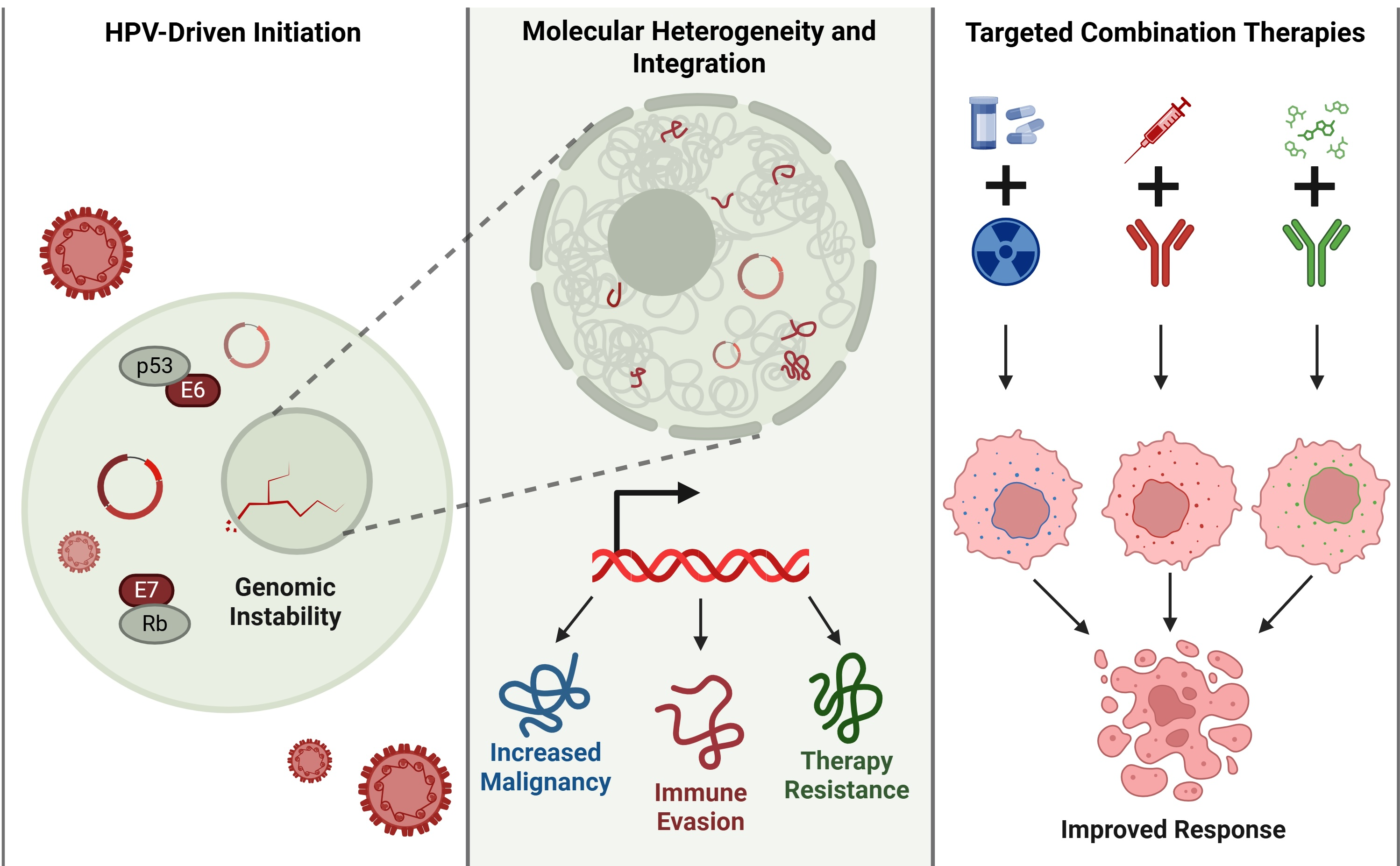
Human papillomavirus (HPV) is a major driver of global cancer incidence, responsible for nearly all cervical cancers and a significant proportion of oropharyngeal, anal, and other anogenital cancers. Despite the availability of effective vaccines, HPV-associated cancers persist due to persistent infection, immune evasion, and the virus’s ability to integrate into the host genome, contributing to molecular heterogeneity and therapeutic resistance. Here, we summarize molecular heterogeneity and the emerging combined therapeutic strategies. High-risk HPV types, notably HPV16 and HPV18, initiate carcinogenesis through persistent infection of epithelial basal cells and through the actions of the E6 and E7 oncoproteins, which disrupt the p53 and Rb pathways, induce telomerase activation, and promote genomic instability. A critical step in the progression to cancer is HPV genome integration, which occurs through DNA damage response pathways and results in heterogeneous insertion patterns that drive oncogene activation, tumor suppressor inactivation, and complex chromosomal rearrangements. Emerging single-cell RNA sequencing studies have highlighted the transcriptional, immune, and spatial heterogeneity of HPV-associated cancers, revealing subpopulations linked to immune escape, therapy resistance, and disease progression. These technologies have uncovered dynamic microenvironmental shifts and distinct immune cell populations, underscoring the importance of cellular and spatial heterogeneity in shaping tumor evolution and treatment response. The "hit and run" hypothesis suggests that while HPV oncoproteins are critical in early carcinogenesis, some tumors may lose dependence on viral oncogenes as they accumulate host genomic alterations, complicating detection and treatment strategies. Heterogeneity in HPV integration patterns and the tumor microenvironment contribute to variable treatment outcomes and the development of resistance to monotherapies. To overcome the challenges posed by molecular heterogeneity in HPV-associated cancers, combined therapeutic strategies targeting viral oncoproteins, host genomic vulnerabilities, and immune microenvironment are essential. Integrating single-cell transcriptomic insights with HPV integration profiles highlights how viral and host heterogeneity shape immune escape and therapeutic response, offering a framework for designing personalized combination therapies to improve outcomes in HPV-associated cancers.
KeywordsHP, viral genome integration, heterogeneity, treatment
Share this article




Copyright © 2026 Pivot Science Publications Corp. - unless otherwise stated | Terms and Conditions | Privacy Policy